
Introduction
Every weekend at autocross paddocks across India—from the dusty tarmac tarmacs of Bangalore and Coimbatore to airport runways and go-kart tracks—you see drivers obsessing over the same upgrades: sticky semi-slick tires, stiffer lowering springs, front strut braces, and cold-air intakes.
Yet, watch those same cars dart through a tight 60-foot slalom gate, and you will spot a glaring problem right through the driver's side window.
The car cuts hard to the left, but the driver slides right. Their shoulders peel away from the seat back, their knees wedge frantically against the door card and center console, and their hands death-grip the top of the steering wheel—not to steer, but to keep their torso upright under 1.1G of lateral acceleration.
If you are fighting to stay seated during rapid transitions, you are not driving your car—you are wrestling it.
Installing dedicated racing seats for autocross is one of the highest-return modifications you can make to your competition car. Far beyond just giving your cockpit a focused motorsport look, a proper racing seat transforms your car's physical dynamics, eliminates sprung weight, and immediately shaves 0.5 to 1.5 seconds off a 60-second autocross run.
Here is the definitive guide to why racing seats belong in your autocross build, how they deliver faster times, how to mount them to your existing factory seat rails using simple custom clamps, and how to choose the right setup.
️ The Physics of Shaving Lap Times: Why Factory Seats Cost You Seconds
Autocross is not track racing. There are no long straights where you can settle into a groove. An autocross course is a non-stop flurry of violent direction changes: 180-degree hairpins, offset slaloms, Chicago boxes, and decreasing-radius sweepers packed into a high-intensity 45 to 60-second sprint.
In this environment, a standard road car seat is your biggest handicap.
♦ . Stopping the "Steering Wheel Tug-of-War"
When your car pulls 1G in a fast corner, an 80 kg driver experiences 80 kg of lateral force trying to throw them across the passenger footwell. Factory seats—designed with broad, flat cushions for comfortable highway cruising and easy ingress/egress—offer virtually zero lateral support.
To keep from tumbling sideways, your brain forces your muscles to compensate:
- You grab the steering wheel with a white-knuckle grip to brace your upper body.
- When your hands are bracing your body weight, your forearms tense up. You lose all sensitivity to steering rack feedback, making smooth counter-steering impossible.
- You end up making choppy, jagged steering inputs, upsetting the front tire contact patch right at the limit of grip.
A purpose-built racing seat features deep lateral thigh, hip, and kidney bolsters. It mechanically captures your pelvis and rib cage. When you enter a high-speed transition, the seat holds your body completely stationary. Your hands remain light, relaxed, and dedicated solely to making micro-corrections on the wheel.
♦ . Precise Throttle & Trail-Braking Modulation
Have you ever tried threshold braking into an autocross stop-box while your lower body is sliding sideways?
If your hips are shifting across the cushion, your right leg is moving relative to the pedal box. A pedal squeeze that should have been 40% pressure turns into 65%, locking the front tires or triggering unwanted ABS intervention. A locked-in racing posture stabilizes your hip sockets, giving your feet a stable mechanical fulcrum to trail-brake precisely down to the millimeter.
♦ . Immediate Chassis "Seat-of-the-Pants" Feedback
Automotive engineers often talk about the "butt dyno", but in autocross, your lower back is your most critical telemetry sensor.
Factory seats are packed with 4 to 6 inches of soft, compliant foam designed to isolate you from road harshness. Unfortunately, that thick foam also acts as a damper that swallows vital chassis signals. By the time you feel the rear tires breaking traction through a squishy factory cushion, your rear axle is already stepping out past the point of recovery.
A rigid racing seat features high-density, thin-profile foam bonded over an ultra-stiff structural shell. Every yaw rate change, front-end push, or curb strike transmits directly into your spine. You detect tire slip milliseconds earlier, allowing you to catch slides before they cost you time.
Shedding Dead Weight: 30+ kg Off the Center of Your Car
In autocross, power-to-weight ratio and rotational inertia dictate how quickly your car rotates through an offset cone slalom. Every kilogram removed from your vehicle improves acceleration, shortens braking distances, and sharpens transient turn-in response.
Yet, many competitors spend thousands on lightweight lithium batteries or forged wheels while leaving two 20-to-25 kg anchors bolted directly in the middle of their car.
| Component | Standard Factory Seat (Single) | Performance Racing Seat (Single) | Weight Difference |
|---|---|---|---|
| Driver Seat Shell + Cushion | 19 – 24 kg | 6.5 kg | -13 to 17.5 kg |
| Passenger Seat | 18 – 22 kg | 6.5 kg | -11.5 to 15.5 kg |
| Total Front Cockpit Mass | 37 – 46 kg | 13 kg | 🔥 Save 24 to 33 kg! |
Note: Factory seat weights reflect common street hatchbacks and sedans with integrated steel reclining mechanisms, height adjusters, side airbags, and heavy internal metal frames.
The Magic of Central Sprung Weight
Shedding 30 kilograms by swapping out factory seats has a far greater dynamic effect than removing the spare wheel from the trunk:
- 1Lowers the Center of Gravity (CoG): Factory seats carry substantial motor and bracket weight up high around your waistline. Replacing them with low-slung, ultra-lightweight racing seats drops the cockpit center of gravity, reducing body roll without needing brutally stiff sway bars.
- 2Reduces Polar Moment of Inertia: Because the driver and passenger seats sit directly between the front and rear axles, lighter seating makes the vehicle rotate faster around its vertical axis. The car snaps into direction changes with significantly less chassis lag.
Aggressive Cockpit Aesthetics: Giving Your Build the Look It Deserves
Performance aside, let’s be honest: nothing transforms the visual personality of a project car quite like opening the door to reveal a pair of aggressive racing seats.
Factory interiors in popular tuner and autocross cars (such as the Maruti Swift, Zen, Honda City VTEC, Esteem, or VW Polo) are overwhelmingly beige or dull grey. They look like commuter appliances.
Installing low-profile, contoured racing seats immediately delivers an unmistakable motorsport aesthetic:
- The Low-Slung Stance: The aggressive silhouette, pronounced shoulder wings, and pronounced side bolsters immediately give your interior the presence of a dedicated club racer.
- Harness Port Detailing: Integrated twin harness shoulder cutouts and lower lap-belt pass-throughs provide a race-ready look whether you run a standard 3-point belt on the street or cinch into a 4-point harness for Sunday timed runs.
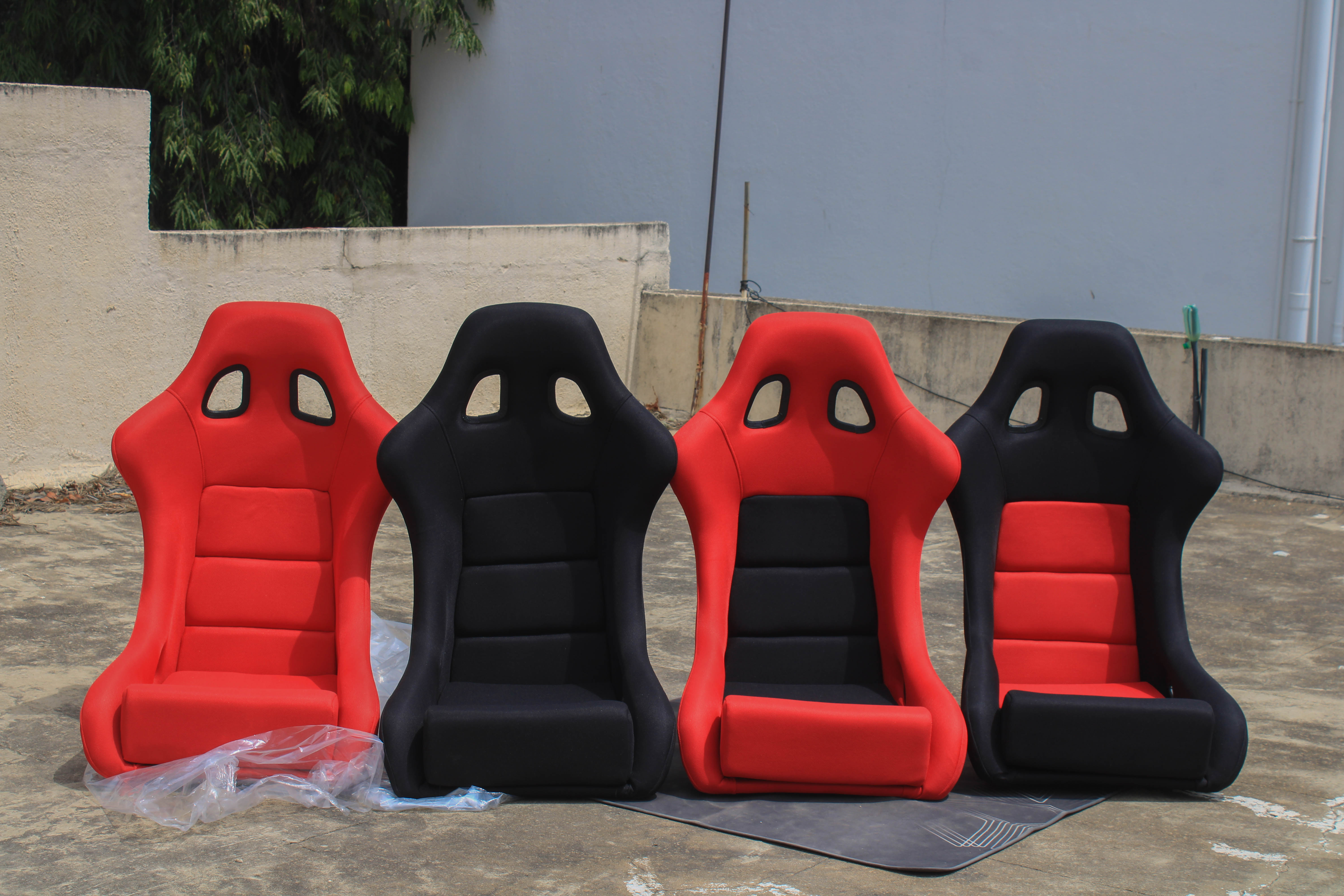
- Personalized Cockpit Styling: Racing seats can be tailored with high-durability, breathable upholstery in striking colors—such as Stealth Black, Track Red, or Royal Blue—to match your car’s exterior livery, brake calipers, or tow straps.
Practical Fitment Guide: Mounting Racing Seats to Existing Stock Rails Using Adapter Clamps
The number one fear keeping grass-roots autocrossers from upgrading their seats is the fear of mounting them. Many drivers assume they need to cut into their car's floorpan, drill new holes, or hunt for rare, expensive imported subframe brackets that cost as much as the seat itself.
You don't.
In grassroots autocross, the most practical, cost-effective, and reversible method is to fabricate a simple steel adapter clamp/bracket system that mates directly onto your car's existing OEM seat sliders.
Why Adapting to Existing Rails Works Best for Autocross:
- 100% Reversible: You don't drill or weld into your car’s chassis floor. If you ever decide to sell the car, you can unbolt the racing seats and reinstall your factory seats in an afternoon.
- Retains Fore/Aft Slide Adjustment: Unlike solid fixed floor brackets, using your factory sliders allows you to slide the seat back and forth. This ensures different drivers (or co-drivers at an autocross event) can dial in their exact distance to the pedals and steering wheel.
- Maintains Factory Floor Geometry: Factory floorpans are rarely flat—they have uneven stamped ridges, catalytic converter humps, and staggered bolt heights. Your stock seat rails are already engineered to sit completely level on those factory studs.
♦ Step-by-Step: How Tuner Garages Build Rail Adapter Clamps
- 1Unbolt and Strip the Factory Seat:
- Disconnect your car's battery (to prevent airbag warning triggers on modern cars).
- Unbolt the 4 factory floor bolts securing your stock seat assembly to the floorpan.
- Remove the seat from the car and unbolt the upper foam backrest and bottom cushion from the bottom slider rails. Most Japanese and European cars have the slider rails bolted to the seat frame via 4 accessible fasteners.
- 1Measure the Spread:
- Measure the center-to-center distance between the mounting holes on your universal racing seat's base (typically standard metric spacing with embedded M8 steel inserts).
- Measure the width between the left and right slider tracks of your factory rail assembly.
- 1Fabricate the Flat Bar / Angle Clamps:
- Using 4mm to 5mm thick structural mild steel flat bar (or 25x25mm structural steel angle), cut two transverse cross-members that span across the left and right rails.
- Drill clearance holes on the ends of the crossbars to bolt securely into the factory slider mounting holes using Grade 8.8 (or higher) high-tensile hardware.
- Drill the corresponding holes in the center span to align with the bottom threaded inserts of your racing seat.
- 1Test-Fit and Set the Seating Angle:
- Autocross seats should not sit bolt-upright like an office chair. A slight backward rake (roughly 5 to 10 degrees of tilt) ensures your hips sink deeply into the bucket, using gravity to wedge you into the bolsters under heavy braking.
- Fine-tune the rake angle by adding stepped washers or machined spacer collars between the front mounting points of the adapter bar.
- 1Torque and Secure:
- Use nylon locknuts (Nyloc) or medium-strength threadlocker (Loctite 242) on all fasteners. High-frequency chassis vibrations in autocross can rattle loose hardware that lacks mechanical locking.
“[!TIP] Keep Your Seat Position as Low as Possible: When measuring your adapter clamp height, always mount the seat base as close to the slider rails as physically possible. Sitting 1 to 2 inches lower than the stock seat significantly drops your personal center of gravity, improves helmet clearance under the roofline, and gives you a much better perspective on apex cones through the windshield.”
️ The Elephant in the Room: Let’s Talk About FIA Certification
When shopping for racing seats, you will frequently see high-end imported seats carrying FIA 8855-1999 or FIA 8855-2021 homologation labels—commanding staggering prices of ₹60,000 to ₹1,50,000+ per seat.
Let's be completely transparent: The racing seats handcrafted by Classic Fiber in Bangalore are NOT FIA certified.
Here is why that honesty matters—and why non-FIA seats are the smart choice for 95% of weekend autocrossers:
Where FIA Certification Is Actually Mandatory:
- National-level Circuit Racing Championships (e.g., MRF / JK Tyre touring car sprints on closed circuits like BIC, MMRT, or Kari).
- High-speed Stage Rallies (INRC) where cars travel 160+ km/h through forested roads lined with trees and ravines.
- International FIA-sanctioned sprint series.
♦ Why Grassroots Autocross Does Not Require FIA Seals:
Autocross is held in open, wide tarmac lots or sealed tracks at controlled speeds (typically under 80 to 90 km/h) navigated around soft plastic cones. There are no other cars on the track alongside you, zero risk of wheel-to-wheel contact, and massive runoff zones.
As a result, grassroots autocross rulebooks (including club-level gymkhanas, time attack challenges, and local speed-runs) do not mandate FIA homologation labels. Tech inspectors look for:
- A rigid, structurally sound monocoque shell with zero crack damage or flex.
- Positive mechanical attachment to the vehicle floor (solid high-tensile bolts and secure rails).
- Safe, functional seatbelts or securely anchored harnesses.
Spending ₹1,00,000+ on imported FIA seats for a weekend autocross build is an unnecessary budget drain. Choosing high-strength, locally fabricated composite racing seats gives you the same rigid lateral hold, the same 6.5 kg lightweight performance, and the same aggressive cockpit styling—while keeping your budget focused where it matters: fresh tires, entry fees, and seat time.
Handcrafted in Bangalore: The Classic Fiber Advantage
For over two decades, Classic Fiber has been Bangalore's trusted name in high-strength composite fabrication. Originally founded for precision automotive and industrial components, our team engineers lightweight racing seats specifically built to handle the brutal, high-G demands of Indian motorsport.
What Sets Classic Fiber Racing Seats Apart:
- 1Engineered for True 1.2G Rigidity: Our racing-purpose shells are built with multi-axial structural composite cloth, ensuring the seat back does not bend or flex under heavy cornering loads.
- 2Featherweight 6.5 kg Shell: Sheds massive sprung mass compared to 20kg+ factory loungers.
- 3Ergonomic Indian Sizing: Designed with a generous internal geometry that comfortably fits drivers up to a 36 to 38-inch waist size (up to ~105 kg) without agonizing rib pinching during extended stints.
- 4Universal M8 Hardpoints: Pre-embedded high-tensile threaded inserts allow easy custom bracket and rail attachment.
- 5Custom Upholstery Options: Available in breathable, wear-resistant automotive fabrics in your choice of Stealth Black, Track Red, or Royal Blue.
- 6In-Person Test-Fit at Our Bangalore Workshop: Don’t guess your fitment online. Drivers across Bangalore and South India are welcome to visit our workshop (168, TC Palya Main Rd, Ashraya Layout, Bengaluru 560036) to sit in the shell, test bolster comfort, and discuss rail bracket fabrication in person.
- 7Pan-India Secure Parcel Shipping: Outside Bangalore? Every seat is crated in multi-layered protective packaging and shipped reliably to your doorstep anywhere in India.
Summary: How to Take Your Autocross Game to the Next Level
Upgrading your suspension and tires without upgrading your seat is like running a marathon in hiking boots. You can have all the mechanical grip in the world, but if your body is sliding across the cabin, you will never unlock your car's true potential.
By switching to lightweight racing seats:
- You shed up to 30 kg of high center mass from your cockpit.
- You lock your torso in place, freeing your hands for precision steering micro-corrections.
- You adapt cleanly to your existing seat rails using simple, reversible steel clamps.
- You give your car an aggressive, track-ready interior presence.
Frequently Asked Questions (FAQ)
Can I use my factory 3-point seatbelt with these racing seats?
Yes. The seats are contoured with lower side cutouts that allow standard automotive seatbelt receivers and belts to route across your hips properly. They are also fully compatible with 4-point and 5-point competition harnesses for track events.
Can these seats recline?
No. These are fixed-back competition shells. Fixed-back seats eliminate the heavy internal hinges and recliner mechanisms found in street seats, maximizing torsional stiffness and safety under hard acceleration and braking. Fore-and-aft adjustment is maintained via your bottom slider rails.
How hard is it to make an adapter clamp for my specific car?
Very straightforward. Any local fabrication garage or tuner workshop can cut and drill two 4mm–5mm mild steel flat bars to bridge between the seat's universal M8 base points and your factory seat sliders in under 2 hours. If you are located in Bangalore, you can also bring your car to our TC Palya workshop.
Will I fit if I have a broader build?
Unlike narrow imported Japanese bucket seats that only cater to slim builds, our shell geometry is specifically designed to accommodate drivers up to a 36–38 inch waist size (~105 kg) with deep, comfortable lateral support.
Get a Custom Fitment Quote on WhatsApp
Ready to transform your autocross cockpit? Chat directly with the fabrication specialists at our Bangalore workshop. We’ll help you choose the right configuration, confirm your rail clamp dimensions, and share fabric options.
👉 Chat with Classic Fiber on WhatsApp (Tell us your vehicle make/model and delivery location for an instant response).