Introduction
In the pantheon of Indian two-stroke legends, few machines evoke raw, untamed adrenaline quite like the TVS-Suzuki family of the 1990s and early 2000s.
While the Yamaha RX100 was the nimble street fighter and the Yamaha RD350 was the aristocratic twin, the Suzuki Shogun was unapologetically feral. Marketed with the legendary tagline "Feel the Surge" and universally christened "The Boss," the Shogun churned out an astonishing 14 bhp at 8,500 RPM from its 108.2cc powerplant. Alongside it stood the Suzuki Shaolin—the 138.2cc 5-speed torque monster—and the sleek, agile Suzuki Supra, completing a trio of machines that defined performance for a generation of riders.
Fast forward to 2026, and these Suzuki two-strokes have become prized collector classics. Enthusiasts across Bangalore, Pune, Chennai, and Delhi are rescuing weathered barn finds and rebuilding them from the bare crank up.
Yet, every restorer running a Suzuki project encounters the exact same heartbreak: the mechanicals can be rebuilt, but the bodywork has practically vanished from existence.
If you are currently rebuilding a Shogun, Shaolin, or Supra, here is your comprehensive field guide to navigating discontinued TVS-Suzuki body panels, understanding model variations, and sourcing period-correct composite reproductions that survive modern road conditions.
The Suzuki Restorer’s Dilemma: Why Parts Are Rarer Than Yamaha’s
If you restore a Yamaha RX100 or RX135, you benefit from a vast ecosystem of aftermarket pattern parts and reproduction panels. But for the TVS-Suzuki 2-stroke family, the supply chain is virtually barren:
- 1Smaller Production Windows: While the Yamaha RX series was produced continuously across multiple decades and platforms, the Shogun (1993–1997) and Shaolin (1998–2000) enjoyed shorter production lifespans. Far fewer spare panels ever sat on regional distributor shelves.
- 2Fragile 90s OEM Plastics: Original TVS-Suzuki body panels were made of lightweight injection-molded ABS plastic. Over 30 years, sun exposure and tropical heat have caused the plasticizers to leach out, leaving the original material brittle like an eggshell.
- 3The 8,500 RPM Vibration Factor: The Shogun’s screaming top-end powerband produces high-frequency harmonics. Under these engine vibrations, weathered OEM plastic snaps right across the mounting tabs and fastener holes.
- 4Astronomical Scrap & NOS Pricing: When genuine New Old Stock (NOS) headlight masks or side shields appear on collector forums, asking prices often exceed ₹5,000 to ₹8,000 for a single plastic piece that is already brittle from three decades of storage.
️ Model-by-Model Bodywork Guide: Shogun vs. Shaolin vs. Supra
Before buying or ordering replacement panels, it is crucial to understand the distinct design signatures and fitment differences between the three models:
♦ . The Suzuki Shogun ("The Boss")
The Shogun’s predatory, front-heavy stance is defined by three hallmark composite pieces:
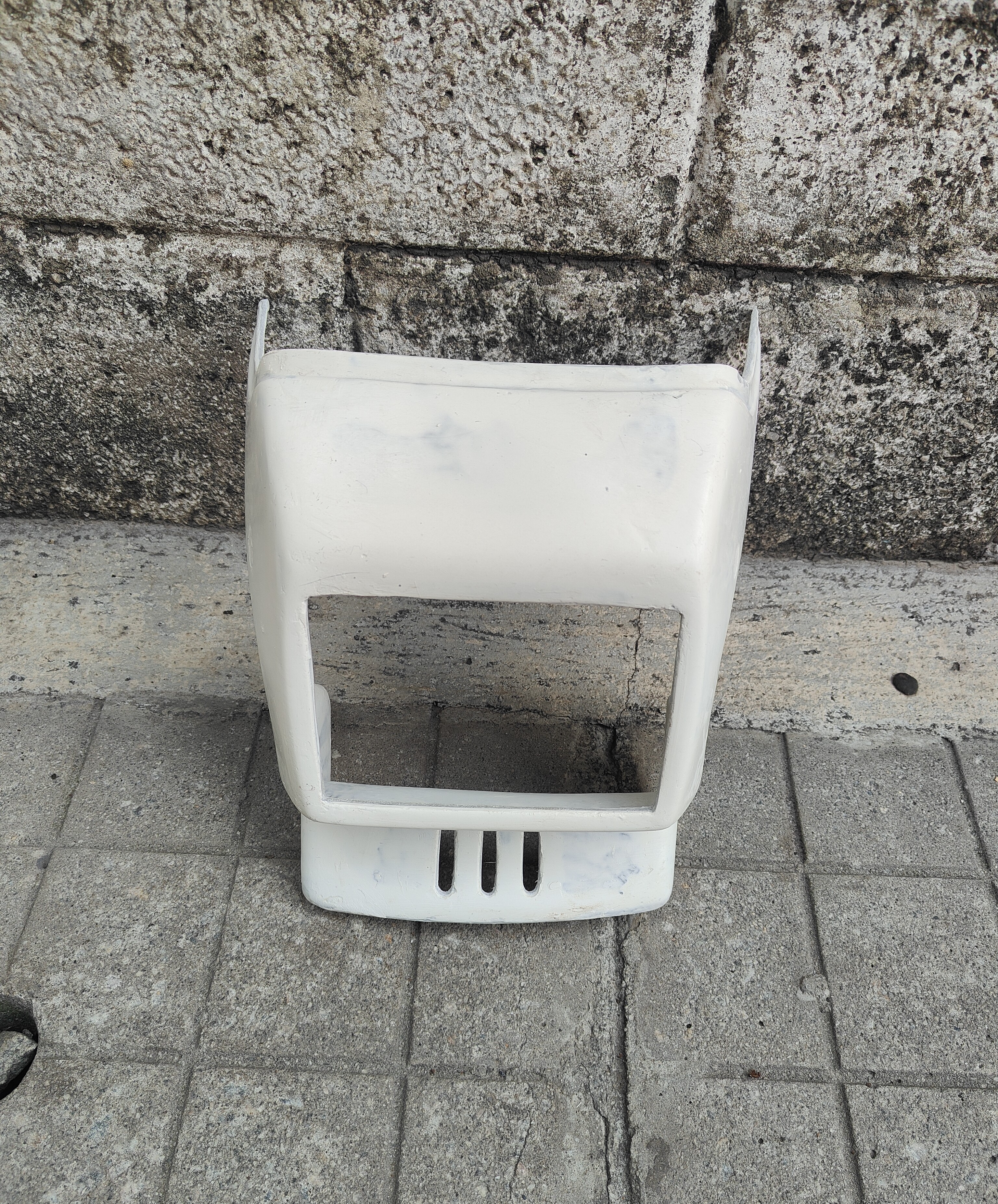
- The Headlight Mask (Front Cowl): The Shogun featured an aggressive square-aperture mask that sat tightly over the headlamp and speedometer assembly. Suzuki produced two distinct style variations: Double Step (D/s) featuring a pronounced dual-tier sculpted intake/groove along the upper brow of the mask delivering a sharper look, and Single Step (S/s) featuring a cleaner single contour over the visor brow.
- The Mask Visor: A compact upper wind deflector cowl that mounts above the headlamp to complete the signature swept-back silhouette.
- Rear Seat Fairing (Tail Cowl): The iconic rectangular ducktail fairing that integrates the rear tail light and turn indicators.
- Side Shields (Battery & Airbox Covers): Sculpted, angular side panels featuring recessed badge areas. The left and right side covers require precise rear locking lugs to interface with the chassis frame grommets.
👉 Explore the Suzuki Shogun Catalog for authentic reproductions.
♦ . The Suzuki Shaolin ("The 5-Speed Beast")
Launched in 1998, the Shaolin was engineered for relaxed, long-legged cruising with a massive 12.3 Nm of low-end torque:
- Front Fairing & Stance: The Shaolin features a broader, more muscular front headlight mask compared to the sharp, razor-thin lines of the Shogun.
- Fuel Tank & Side Panel Contours: Because the Shaolin utilized a larger frame backbone and wider seat profile, the side panels are distinct in their curvature and locking peg spacing.
- Tail Section: A wider, more substantial rear tail cowl designed to match its thicker two-up touring seat.
👉 Explore the Suzuki Shaolin Catalog for bespoke panel fabrications.
♦ . The Suzuki Supra
The Supra bridged the gap between the everyday reliability of the Samurai and the aggressive sport credentials of the Shogun:
- Sleek Aerodynamics: The Supra’s headlight cowl and side shields featured subtle, flowing curves rather than the razor-sharp steps of the Shogun.
- Interchangeability Alert: While some chassis mounting locations are shared across the Samurai/Supra family, mounting brackets and headlight stay dimensions often differ from the Shogun. Always verify your stay bracket before ordering.
👉 Explore the Suzuki Supra Catalog for custom reproductions.
️ Sourcing Comparison: OEM / Junkyard vs. Hand-Laid Fiberglass
When completing a high-end 2-stroke restoration, builders typically evaluate three sourcing paths:
| Feature / Criteria | 30-Year-Old OEM / NOS | Scrap Market / Junkyard | Handcrafted Fiberglass (Classic Fiber) |
|---|---|---|---|
| Material Integrity | Dry, leached plasticizers | High UV degradation, brittle | High-tensile woven marine fiberglass |
| Vibration Durability | Snaps under 2-stroke harmonics | Prone to immediate cracking | Engineered multi-layer flexural strength |
| Mounting Tab Strength | Brittle factory ABS lugs | Often broken or glued back on | Reinforced, hand-laminated mounting ears |
| Surface Finish | Faded or scratched base | Deep gouges, sun damage | Smooth raw gelcoat ("Without Paint") |
| Paint Adhesion | Risk of solvent reaction | Needs heavy putty fill | Directly accepts 2K automotive primers |
| Availability | Pure luck on classifieds | Scrap digging in local markets | Made to Order in 5–7 Working Days |
️ The Restoration Roadmap: Fitting Fiberglass Panels to Your Suzuki
Because vintage motorcycle frames can show slight alignment variations after decades of riding and rebuilds, follow this proven workshop checklist when installing new composite panels:
♦ . Always "Dry Fit" Before Touching Paint
Never send a newly acquired fiberglass part directly to your paint shop without test-fitting it to your actual motorcycle first:
- Mount your headlight stay, speedometer bracket, and indicator stems.
- Place the raw headlight mask over the stay to check clearance around the wiring harness and cables.
♦ . Pilot Drill and Use Rubber Grommets (Crucial!)
Two-stroke single-cylinder engines produce intense high-RPM vibration:
- When drilling holes for mounting screws, use a sharp, high-speed drill bit without exerting heavy downward pressure.
- Never bolt a fiberglass panel metal-to-metal directly against your steel chassis. Always install broad rubber chassis grommets and nylon washers. The rubber absorbs engine buzz and prevents hairline stress cracks around the bolt holes for years to come.
♦ . Surface Prep, Primer & Factory Paint Match
All Classic Fiber Suzuki components are delivered in a raw, unpainted finish ("Without Paint"):
- Lightly sand the gelcoat surface with 400-grit wet sandpaper to create a mechanical key.
- Apply a coat of high-build 2K epoxy or polyurethane grey primer.
- Spray your period-correct factory color—such as the iconic Shogun Jet Black, Candy Red, or Supra Metallic Blue—apply replica water-transfer or vinyl graphics, and seal under a UV-protective high-gloss 2K clear coat.
Behind the Craft: 23+ Years of Composite Experience
At Classic Fiber, we have been restoring and fabricating custom composite motorcycle bodywork in Bangalore since 2003.
We don't manufacture generic universal parts that sort-of-fit. Our Suzuki Shogun, Shaolin, and Supra moulds were precision-cast from authentic, undamaged original panels. Every headlight mask, visor, and tail cowl that leaves our workshop is individually hand-laid by our master composite team using multi-axial fiberglass cloth and high-tensile resin formulations.
Whether you are completing a showroom restoration in Bangalore or rebuilding your dream two-stroke in Kerala, Mumbai, or Delhi, we provide the authentic bodywork you need to bring "The Boss" back to life.
Frequently Asked Questions (FAQ)
What is the difference between Shogun D/s and S/s headlight masks?
D/s (Double Step) features a distinctive double-groove aerodynamic scoop across the upper brow of the mask, giving the bike an aggressive, sculpted face. S/s (Single Step) features a smoother, classic single-step contour matching the early 1993–1994 factory aesthetic.
Are Suzuki Shogun and Shaolin side panels interchangeable?
No. While they look superficially similar from afar, the Shaolin uses a wider chassis subframe and distinct battery/airbox clearances. Attempting to force a Shogun side panel onto a Shaolin frame will cause tension on the locking lugs and misalign the seat contour.
Do Classic Fiber’s Suzuki parts come painted?
No. All parts are supplied in a raw, unpainted gelcoat finish. This ensures you or your automotive painter can perfectly match your build's specific paint shade, vintage stripe decals, and clear coat depth without dealing with pre-applied low-grade paint.
How long does custom fabrication and Pan-India shipping take?
Our standard handcrafted fabrication lead time is 5 to 7 working days. Once finished, parts are packed with heavy-duty multi-layer bubble wrap and corrugated crating for secure door delivery anywhere in India.
Can I bring my Suzuki two-stroke to your Bangalore workshop?
Yes! Enthusiasts and builders are always welcome to visit our physical workshop and retail facility at 168, Thambu Chetty Palya Main Rd, Ashraya Layout, Bengaluru, Karnataka 560036. We can assist with test-fitting, custom adjustments, and mounting guidance on-site.
Inquire on WhatsApp
Ready to complete your Suzuki 2-stroke restoration? Don't let a missing headlight mask or shattered tail cowl stall your build. Talk directly to our workshop team: Click here to chat with Classic Fiber on WhatsApp to discuss replica parts, get custom fabrication advice, or request a Pan-India shipping quote.